


AI in supply chain management has moved past the question of whether to use it. The question now is how deeply to embed it and what the handoff between human judgement and machine processing should look like.
That question sits at the heart of what practitioners are calling the cyborg supply chain: a model where AI capability and human expertise reinforce each other rather than compete for the same territory.
What AI actually does in supply chain management
Artificial intelligence contributes most where data volume overwhelms human processing speed. Demand forecasting is the clearest example. Machine learning models can analyse purchasing patterns, weather data, economic indicators and promotional calendars simultaneously. Tasks that would take an analyst days are completed in seconds. Large consumer goods manufacturers running AI-powered forecasting have publicly described double-digit accuracy gains over legacy planning, with corresponding reductions in both overstock and stock-outs. The pattern is most visible in food and beverage supply chains, where demand volatility punishes weak forecasting more severely than in other categories.
Operations visibility is a second area where AI delivers measurable results. Real-time monitoring systems flag anomalies in transit times, carrier performance and warehouse throughput as they happen, enabling proactive responses rather than post-event fire-fighting. Companies running mature AI capabilities consistently outperform peers still relying on rule-based planning and manual reporting.
Prescriptive analytics takes this further. Rather than showing what happened or predicting what will happen, prescriptive systems recommend specific actions: which supplier to switch to given a disruption, which warehouse to pull stock from given a sudden demand spike, which route to avoid given live traffic and weather data. This is AI operating as a planning co-pilot, not a reporting tool.
Large language models are reshaping back-office operations too. Customer service and supplier communications consume significant time for logistics coordinators. LLMs handle them faster by drafting responses, flagging exceptions and summarising long email threads. Teams still running these processes through spreadsheet-based tools are missing a growing efficiency gap.
“AI effectively is a lens, not a brain. The best compliment FLOX gets is silence — because it means the system is doing its job and customers can focus on theirs.”
Wajahat Akram, CTO of FLOX.is

The cyborg supply chain: humans and AI in partnership
Industry 5.0 reframes the conversation. Where Industry 4.0 focused on automation, Industry 5.0 explicitly reintroduces the human element as a feature rather than a legacy. In supply chain terms, that means designing systems where AI handles the data-intensive work and people handle the judgement-intensive work. The result is not a compromise. It is an architecture built for resilience.
Look at the operators running automation at scale. Amazon operates a fleet of hundreds of thousands of warehouse robots, yet continues to grow its human workforce in those same facilities. JD.com runs near-fully automated warehouses in China for certain product categories whilst simultaneously expanding its human-staffed logistics teams for complex, high-value deliveries. In both cases, the operators have found that full automation works for predictable, high-volume flows. Human judgement remains essential everywhere else.
The concept of the human-machine boundary is useful here. This is not a fixed line but a dynamic one. As AI systems improve, some decisions that once required human input become automatable. New complexities continuously push the boundary back. New suppliers, new regulations and new market conditions create fresh domains where human experience matters. Managing that boundary actively, rather than letting it drift, is one of the defining supply chain leadership challenges of this decade.
What makes the cyborg model work is not the technology itself but the organisational design around it. Teams need to understand what the AI is doing and why, so they can intervene intelligently when it is wrong. They need feedback loops that surface AI errors quickly. And they need a culture that treats AI as a tool to be questioned, not an oracle to be obeyed. In multi-party logistics, that organisational infrastructure has to extend across buyers, warehouse providers, 3PLs and hauliers. Without it, even the best algorithms become a liability.
The real challenges of AI adoption in logistics
The case for AI in supply chain is clear in theory. The implementation reality is considerably messier. Organisations that have attempted large-scale AI deployments consistently report the same set of obstacles. Understanding them honestly is the first step to avoiding them.
Data quality is the foundational challenge. AI systems are only as good as the data they learn from. Most supply chain datasets are deeply imperfect. Inconsistent SKU naming conventions, incomplete historical records, supplier data in incompatible formats and legacy systems that were never designed for interoperability: these are not edge cases but the norm. Before any AI system can deliver value, substantial investment in data infrastructure is typically required. Organisations that skip this step and jump straight to model deployment end up with sophisticated tools producing unreliable outputs.
Integration complexity follows closely. Enterprise supply chains run on a patchwork of ERP systems, warehouse management platforms, transport management software and third-party logistics portals, many of which were built in different eras and speak different technical languages. Connecting a new AI layer to this infrastructure is rarely as straightforward as vendors suggest. The integration work frequently accounts for the majority of implementation cost and timeline. It requires technical expertise that many logistics organisations do not have in-house.
Change management is the challenge that is most frequently underestimated. Supply chain teams have often developed their expertise over years of direct experience. Asking them to trust an algorithm's recommendation over their own judgement is not a trivial request. Resistance is not irrational. Experienced professionals have seen plenty of new systems that promised transformation and delivered disruption. Building genuine confidence in AI tools takes three things at once: transparent communication about how decisions are made, clear evidence of performance improvements and visible leadership commitment to human expertise.
Finally, there is the question of accountability. When an AI-driven demand forecast is wrong and a retailer runs out of stock during a peak period, who is responsible? The algorithm cannot be held accountable. The organisation can. Establishing clear ownership of AI-assisted decisions is both ethical and practical. Human sign-off should remain part of high-stakes processes.


Wajahat Akram
CTO of FLOX.is
Chain Reaction Podcasts
AI Is a Lens, Not a Brain
Most logistics platforms are built for databases, not operators. Wajahat explains why FLOX started from user workflows outward — and where AI genuinely adds value versus hype.
Building a balanced AI integration strategy
The organisations that get AI integration right tend to share a common approach: they start with a specific, measurable problem rather than a broad ambition. "Implement AI across the supply chain" is not a strategy. "Reduce forecast error in our top 20 product categories by 15% within 12 months" is. Specificity creates accountability, makes success measurable and prevents the scope creep that kills most enterprise technology programmes.
From that specific starting point, a balanced integration strategy typically follows a four-stage pattern. The first stage is data readiness: auditing existing data sources, standardising formats, filling gaps and establishing governance processes that keep data clean over time. This stage is unglamorous but non-negotiable. The second stage is pilot deployment: selecting one use case, implementing the AI tool, measuring outcomes rigorously and documenting what worked and what did not. A pilot that fails is not a failed programme. It is valuable learning, provided the failure modes are understood.
The third stage is human calibration: working with the operational teams who will use the AI output daily to build their understanding of its capabilities and limits. This is not a training session. It is an ongoing process of collaborative learning. Experienced supply chain professionals often catch AI errors that a purely technical team would miss, because they understand the context that the model cannot fully capture: the seasonal quirks, the supplier relationships, the customer behaviour patterns. Treating these professionals as partners in the process, rather than recipients of a new tool, makes the whole system more robust.
Scaled deployment with embedded oversight is the fourth stage. As the AI system demonstrates reliable performance across more use cases, the scope expands. So does the governance infrastructure. Clear escalation paths, regular model audits and defined intervention protocols keep the system trustworthy as it grows more capable.
AI in supply chain practice: a framework by use case
Rather than thinking about AI as a single technology, it helps to map specific AI capabilities to specific supply chain challenges. The table below sets out the primary use cases, the AI approach best suited to each, the maturity level required and the performance gains organisations have reported in published implementations. The ranges are illustrative, drawn from supply chain AI literature published 2023-2025.
| Use Case | AI Approach | Maturity Required | Typical Performance Gain |
|---|---|---|---|
| Demand forecasting | Machine learning on historical sales, weather and external signals | Moderate | 20-50% reduction in forecast error |
| Inventory optimisation | Reinforcement learning; multi-echelon modelling | Moderate-High | 10-30% reduction in holding costs |
| Supplier risk monitoring | NLP on news, financial and regulatory data | Low-Moderate | Earlier risk detection; reduced disruption exposure |
| Route optimisation | Combinatorial optimisation; real-time traffic integration | Low | 5-15% reduction in transport costs |
| Warehouse automation | Computer vision; robotic process automation | High | 30-50% increase in pick productivity |
| Quality inspection | Computer vision on production line imagery | Moderate | 85-99% defect detection rates |
| Contract and procurement | NLP for clause extraction and anomaly detection | Low-Moderate | 60-80% reduction in manual review time |
Two patterns emerge from this framework. First, the use cases with the lowest maturity requirements often deliver strong ROI. Route optimisation, supplier risk monitoring and procurement analytics sit in this category precisely because they do not require the deep data infrastructure that more sophisticated applications demand. Starting there builds the organisational capability and confidence to tackle the harder problems later. Second, the highest-maturity use cases require substantial capital investment and technical expertise. Warehouse automation and reinforcement learning for inventory are not starting points. They are destinations.

What changes for supply chain professionals
The most important thing to understand about AI in supply chain management is what it does not change. AI does not replace the need for deep domain knowledge. It does not eliminate the value of strong supplier relationships. Resilience does not become automatic. What changes is where human expertise gets applied and what tools are available to apply it.
For supply chain leaders, the strategic priorities evolve. The question shifts from "how do we manage this complexity manually?" to "how do we design integrated human-machine systems that handle complexity well?" That is a different leadership challenge. It requires a different skill set: the ability to evaluate AI tools critically, build data infrastructure that supports them and develop organisations that use them intelligently.
Operational teams feel the change more immediately. The role of the experienced planner, buyer or logistics coordinator does not disappear. It evolves. Routine pattern-matching becomes automated. Human value concentrates in the work that remains genuinely difficult: exception management, supplier negotiation, cross-functional problem-solving and strategic judgement under uncertainty. These are the capabilities experienced professionals have always brought to the table. AI makes them more important, not less.
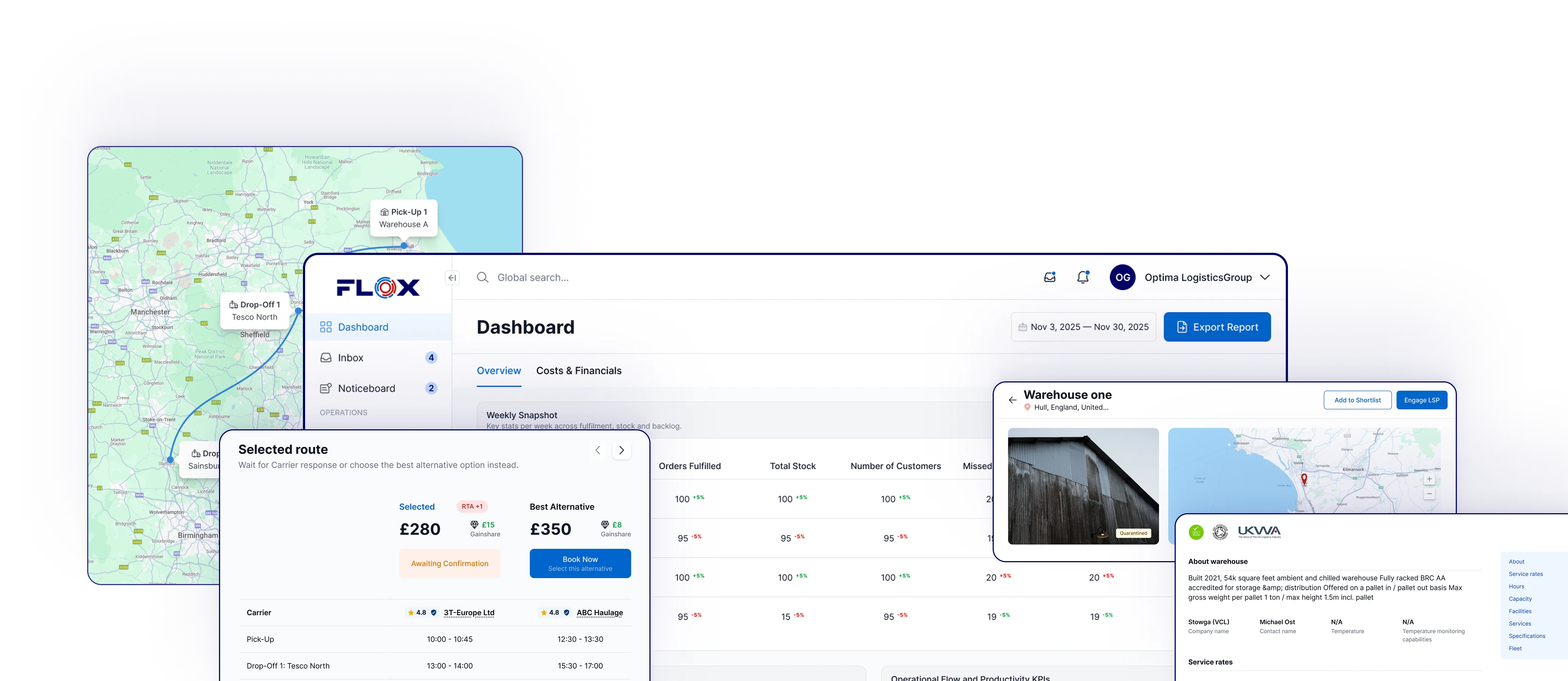
The supply chains that perform best over the next decade are unlikely to be those that have deployed the most AI or those that have resisted it most stubbornly. They will be the ones that have thought carefully about how human and machine intelligence complement each other and then built organisations to bring both to bear deliberately. Across multi-party logistics, that thinking has to extend beyond a single team. It has to coordinate buyers, warehouse providers, hauliers and 3PLs running on different systems. That is the territory FLOX was built for: a marketplace and orchestration platform where AI handles coordination at scale and humans own the exceptions that matter. The question is not a technology one. It is a leadership one.

Ask anything to learn how FLOX works and helps buyers and sellers of logistics run more efficient and profitable operations.
Subscribe to our newsletter.
Stay up to date with practical insights and useful logistics content
FAQs
The cyborg supply chain describes an operational model where human expertise and AI capability work together rather than compete. AI handles data processing at scale: demand forecasting, route optimisation, anomaly detection. Humans apply context, judgement and relational intelligence that AI systems lack. The model acknowledges that neither humans nor machines alone produce optimal outcomes. The boundary between what gets delegated to AI and what stays with humans shifts as both the technology and the workforce's AI fluency develop.